
Over the past year, federal discussions about artificial intelligence have begun to change in a subtle but important way.
For much of the AI boom, the conversation focused primarily on technology. Agencies explored potential use cases. Vendors highlighted model capabilities. Industry conferences filled with discussions about generative AI, automation, productivity gains, and digital transformation.
Increasingly, however, the conversation is shifting from what AI can do to how AI should be acquired, governed, evaluated, and managed.
That distinction matters.
Federal agencies have purchased emerging technologies for decades. Artificial intelligence is not the first innovation to generate excitement, and it will not be the last. What makes the current moment different is the growing effort across government to build acquisition and governance frameworks around AI systems and services.
Recent Office of Management and Budget guidance, agency implementation efforts, procurement initiatives, and emerging contract language all point in a similar direction. Agencies are beginning to ask more sophisticated questions about data rights, transparency, testing, monitoring, privacy, vendor lock-in, and long-term operational risk. In some cases, those questions are already appearing in acquisition artifacts.
The Department of Housing and Urban Development has established agency-specific acquisition clauses addressing AI-related issues such as transparency, privacy, intellectual property, and monitoring. NASA has used acquisition language requiring offerors to disclose planned AI use during contract performance. The Internal Revenue Service has published contract language requiring vendors to identify instances of AI used in product development and capabilities. The Department of Defense continues to expand acquisition pathways and evaluation approaches designed specifically for AI-enabled technologies.
None of these developments establish a government-wide requirement. There is no universal Federal Acquisition Regulation clause governing AI acquisition. Agency implementation remains uneven, and many AI-related opportunities continue to be acquired through traditional information technology procurement processes.
Yet viewed collectively, these developments suggest that federal AI opportunities are becoming more disciplined than many contractors realize.
These examples remain agency-specific rather than governmentwide. Nevertheless, they illustrate a broader trend: AI considerations are beginning to appear in acquisition planning, solicitation language, contract clauses, evaluation activities, and post-award oversight. While implementation varies considerably across agencies, the trajectory is becoming increasingly visible.
That observation has important implications for how organizations pursue the market.
For many years, federal technology companies could focus primarily on capability. If the solution worked, met security requirements, addressed a mission need, and could be delivered at an acceptable price, the organization was generally positioned to compete.
Those fundamentals still matter.
What is changing is the growing expectation that contractors be prepared to explain not only what their AI systems do, but how they are governed, how they are deployed, how risks are managed, and how they support the agency's broader acquisition objectives.
In other words, AI capability and AI procurement readiness are not necessarily the same thing.
A company may possess sophisticated models, strong engineering talent, and compelling technology while remaining poorly positioned for a federal AI pursuit. Conversely, organizations with more modest technical capabilities may compete effectively because they understand how federal buyers evaluate risk, governance, implementation, and long-term sustainability.
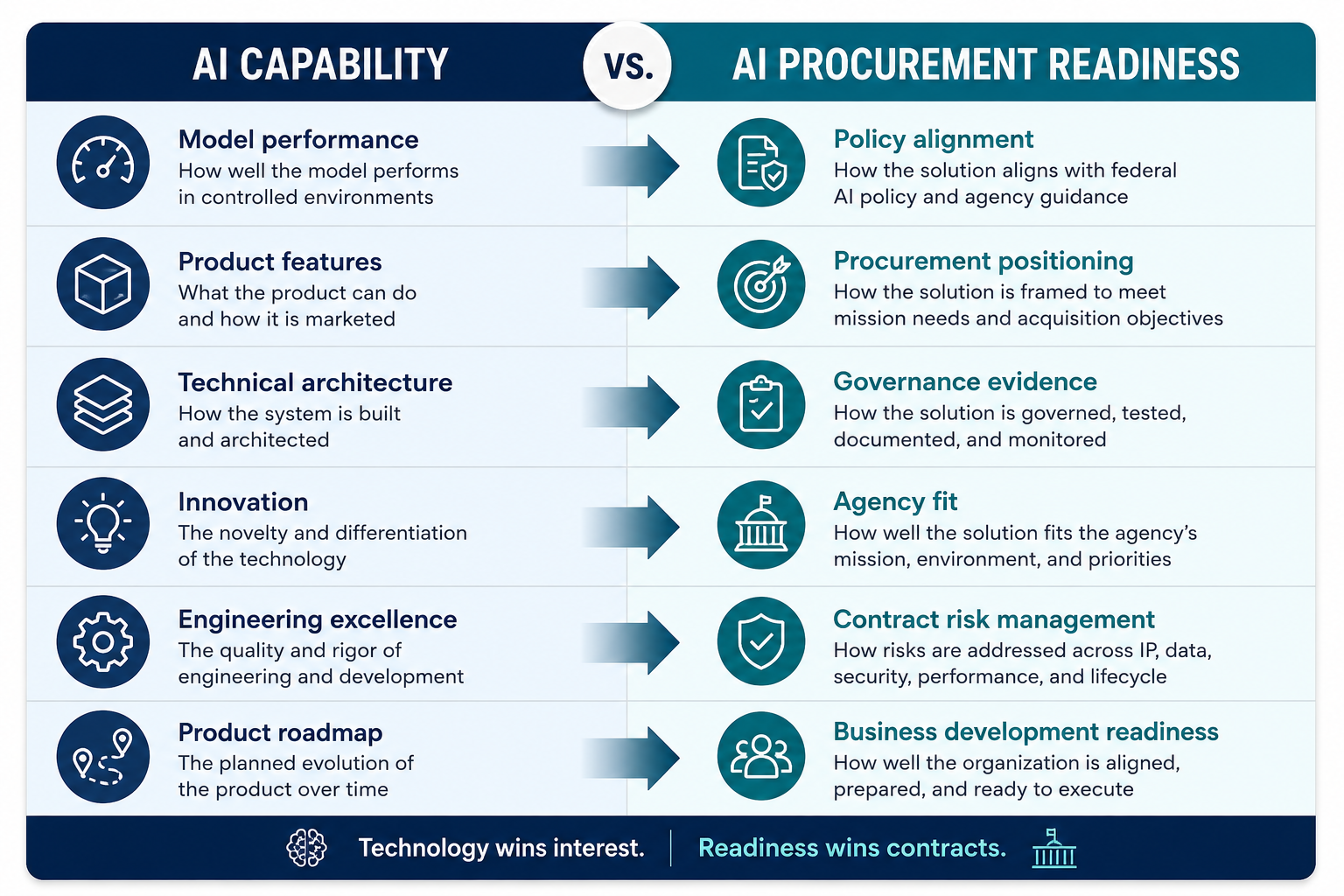
The organizations navigating this transition most effectively tend to approach AI opportunities through a broader procurement lens. As federal AI acquisition continues to evolve, six questions increasingly help distinguish organizations that are prepared for serious pursuits from those that are still approaching AI primarily as a technology conversation.
1. Are We Aligned With Current Federal AI Policy?
Contractors do not need to become policy experts. They do, however, need to understand the environment in which agencies are making acquisition decisions.
Federal agencies are implementing AI within a framework shaped by OMB Memoranda M-25-21 and M-25-22, agency-specific governance efforts, and emerging acquisition guidance. These policies do not create a universal contractor compliance regime, but they do influence how agencies think about AI governance, acquisition planning, testing, monitoring, and risk management.
Organizations that ignore these developments often encounter them later under less favorable circumstances. A capability that appears attractive from a technical perspective may raise concerns when viewed through an agency's governance or acquisition lens. Conversely, organizations that understand the policy environment can often position themselves more effectively before a solicitation is released.
The objective is not policy mastery. It is policy awareness. Contractors should be able to explain how their offerings fit within the environment their customers are operating in and how those offerings help agencies adopt AI while managing the responsibilities that accompany it.
2. Is Our AI Positioning Procurement-Credible?
Many AI companies describe their offerings using language designed for investors, commercial customers, or technology audiences.
Federal buyers often evaluate those same claims differently.
Contracting officers, program managers, and evaluators are not purchasing innovation for its own sake. They are purchasing outcomes. They are evaluating whether a proposed solution can solve a mission problem, perform reliably, integrate into an operational environment, and withstand scrutiny throughout the acquisition lifecycle.
As a result, procurement credibility is often built through precision rather than ambition.
Organizations that can clearly explain what a system does, what data it requires, how performance is measured, where limitations exist, and how success will be evaluated tend to establish greater confidence than those relying on broad claims about transformation or disruption.
This distinction becomes particularly important in AI-related procurements because agencies are increasingly seeking evidence that proposed capabilities can perform under real-world conditions rather than simply demonstrating promise in theory.
3. Can We Substantiate Our AI Claims?
One of the clearest themes emerging from federal AI acquisition guidance is the growing importance of evidence.
Increasingly, agencies are being encouraged to test AI solutions, evaluate risks, monitor performance, and obtain sufficient information to support acquisition and governance decisions. For high-impact AI applications and certain large language model procurements, agencies may need documentation that helps satisfy their own oversight responsibilities.
This is where governance becomes less about ethics discussions and more about procurement credibility.
Agencies need confidence that AI systems can be understood, monitored, evaluated, and managed throughout the contract lifecycle. They need confidence that performance claims can be supported, risks can be addressed, and operational issues can be identified before they become mission problems.
For contractors, this raises a straightforward question: can we demonstrate why our claims should be trusted?
Organizations that can provide clear documentation, testing evidence, oversight mechanisms, security controls, and performance data will often appear more credible than those relying solely on marketing narratives. The strongest competitors increasingly differentiate themselves not only through what their technology can do, but through the evidence they can provide to support it.
4. Are We Pursuing the Right Agencies?
One of the most expensive mistakes in federal business development is treating the federal government as a single customer.
It is not.
Different agencies are approaching AI from different operational realities, governance structures, risk tolerances, and mission requirements.
The Department of Veterans Affairs is focused on healthcare delivery and veteran services. The Internal Revenue Service must navigate taxpayer privacy, security, and public trust concerns. The Department of Defense emphasizes operational performance, testing, and mission effectiveness. The Department of Health and Human Services faces unique challenges involving healthcare data and high-impact uses. The General Services Administration plays a growing role in procurement channels and government-wide acquisition strategies.
These differences matter.
A compelling AI narrative for one agency may have limited relevance for another. The organizations most likely to succeed are often those that understand not only the technology, but also the institution purchasing it.
Agency fit is frequently discussed as a business development consideration. Increasingly, it is becoming a risk-reduction strategy as well.
5. Have We Evaluated the Contract Risk?
Many discussions about artificial intelligence focus on technology.
Federal acquisitions ultimately become contracts.
That simple reality has significant implications for AI pursuits.
Recent federal guidance increasingly highlights issues involving intellectual property, data rights, privacy, authorization to operate, portability, monitoring, vendor lock-in, lifecycle management, and long-term sustainability. These issues may appear secondary during early business development conversations. They rarely remain secondary once an acquisition moves toward award.
A capability statement can describe an aspiration. A proposal may create a representation. A contract can transform that representation into an obligation.
That progression deserves more attention than it often receives.
Organizations pursuing AI opportunities should evaluate not only whether they can win the work, but whether they can comfortably perform under the commitments they are making. Claims involving automation, accuracy, explainability, oversight, interoperability, security, or data usage may ultimately become subjects of contract administration rather than marketing.
The most successful contractors often begin evaluating contract risk long before negotiations begin. They recognize that procurement success is not measured solely by winning the work. It is measured by successfully performing it.
6. Is Our Business Development Organization Ready?
The final question may be the most important because it influences all of the others.
Federal AI pursuits rarely succeed because of technology alone. They require coordination across leadership, capture, business development, legal, contracts, compliance, delivery, and technical teams.
Yet many organizations approach AI opportunities with inconsistent messaging, unclear governance narratives, unsupported claims, or unresolved internal disagreements regarding acceptable risk.
Those issues often remain hidden until proposal development begins.
By then, timelines are compressed, positions have hardened, and options become limited.
The strongest organizations establish alignment before opportunities emerge. They ensure that leadership, business development, legal, contracts, and technical teams share a common understanding of the offering, the evidence supporting it, and the commitments the company is prepared to make.
In many cases, readiness is not created during a pursuit.
It is revealed.
The Companies That Prepare Early Will Have an Advantage
The most significant shift occurring in federal AI acquisition is not that agencies are buying artificial intelligence. Agencies have always sought technologies capable of improving mission performance.
The more consequential shift is that agencies are becoming increasingly sophisticated in how they evaluate, govern, acquire, and manage those technologies.
That evolution remains uneven. Some agencies are moving faster than others. Some procurements will continue to resemble traditional technology acquisitions. Many opportunities will still be won on familiar factors such as technical merit, past performance, security, schedule, and price.
Even so, the direction of travel is becoming clearer.
For years, the competitive question was whether a contractor could demonstrate AI capability.
Increasingly, the more important question may be whether a contractor can demonstrate AI readiness.
Those are not the same thing.
The organizations that recognize the difference early, and prepare accordingly, will likely enter the next generation of federal AI competitions with a meaningful advantage.
