
Most federal contractors are watching artificial intelligence policy.
Fewer are asking how that policy may affect procurement.
That distinction matters.
Across government, artificial intelligence is moving beyond strategy documents and governance frameworks. In a growing number of cases, it is beginning to influence acquisition planning, vendor evaluation, contract requirements, and performance oversight.
The shift is neither complete nor uniform. Agencies remain at different stages of implementation, and a comprehensive government-wide AI acquisition regime has not yet emerged.
But the direction of travel is increasingly clear.
For contractors, AI policy is no longer simply a technology issue. It is becoming a procurement issue.
Executive Takeaway
Federal AI policy is increasingly influencing how agencies plan acquisitions, evaluate vendors, structure contracts, and oversee performance. While implementation remains uneven, contractors should expect growing attention to AI governance, testing, documentation, accountability, data management, and human oversight. Organizations that prepare before those expectations become explicit will be better positioned than those that wait for solicitation language to force the issue.
The Kettle Hill Policy-to-Procurement Framework
Many organizations monitor policy developments and stop there.
The more important question is what happens next.
At Kettle Hill Advisory, we evaluate federal AI developments through what we call the Kettle Hill Policy-to-Procurement Framework:
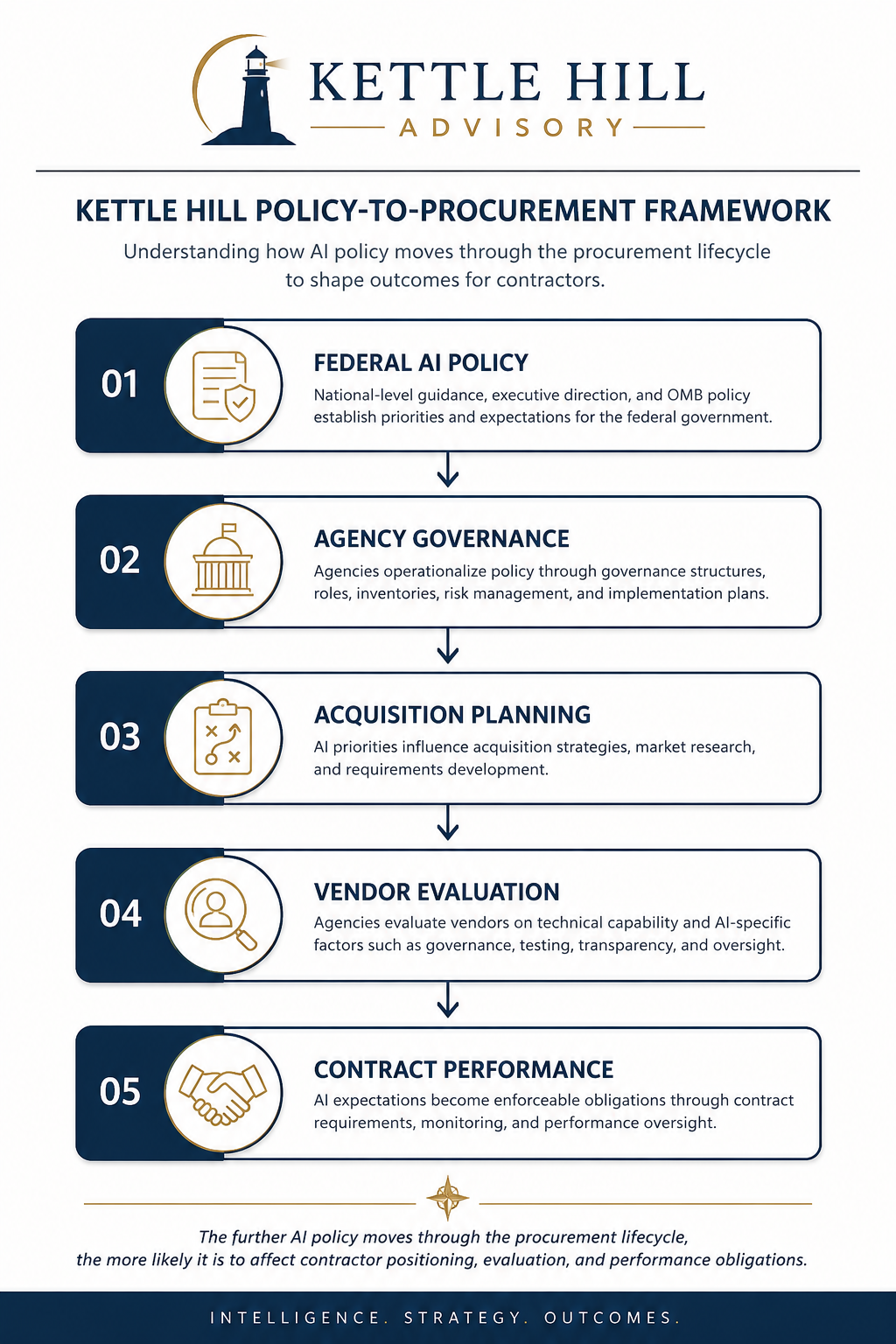
Most market participants focus on the first stage.
Procurement outcomes are often shaped by the stages that follow.
Policy establishes direction. Governance creates accountability. Acquisition planning translates objectives into buying strategies. Evaluation determines what agencies expect from vendors. Contract performance turns those expectations into enforceable obligations.
Organizations that understand this progression early generally have more time to adjust their positioning, governance practices, documentation, and business development strategy before requirements appear in active procurements.
OMB Has Created the Policy-to-Procurement Bridge
The clearest evidence of this transition can be found in recent Office of Management and Budget guidance.
The federal government’s current AI governance framework is established through OMB Memorandum M-25-21, which requires agencies to maintain Chief AI Officers, AI Governance Boards, compliance plans, AI inventories, public AI strategies, and oversight mechanisms for higher-impact AI use cases.
Viewed in isolation, M-25-21 appears to be primarily an internal governance document.
Its significance becomes more apparent when paired with OMB Memorandum M-25-22, which addresses the acquisition of artificial intelligence systems and services throughout the procurement lifecycle.
M-25-22 directs agencies to incorporate AI considerations into acquisition planning, market research, solicitation development, contract administration, and contract closeout.
The importance of this development is not that every procurement now contains AI-specific requirements.
The importance is that agencies now have a formal basis for asking different questions.
Questions involving testing, transparency, human oversight, accountability, monitoring, data rights, vendor lock-in, and lifecycle management are increasingly becoming acquisition considerations rather than purely technical considerations.
This is where AI governance begins to enter procurement.
AI Is Creating a New Category of Procurement Evidence
Historically, federal contractors have been expected to provide evidence in familiar categories.
Can the company perform the work?
Does it have relevant past performance?
Can it staff the requirement?
Does it possess the necessary technical capabilities?
Does it have a credible management approach?
Those questions are not going away.
However, AI is creating a new category of procurement evidence.
For organizations offering AI-enabled products or services, agencies may increasingly seek evidence related to:
AI governance practices
Testing and validation methodologies
Human oversight mechanisms
Data provenance and management
Model documentation
Risk management processes
Transparency controls
Monitoring capabilities
Accountability structures
The issue is no longer simply whether a company uses artificial intelligence.
The issue is whether that company can credibly explain, document, govern, monitor, and support its use of artificial intelligence in a federal environment.
That is a fundamentally different standard.
The Trend Is Becoming Visible in Procurement Practice
Policy documents alone do not establish a market trend.
The more important question is whether those policies are beginning to influence acquisition behavior.
Increasingly, the answer appears to be yes.
At the agency level, the Department of Energy has begun translating responsible AI concepts into acquisition practice through Acquisition Letter 2026-05, which addresses evaluation considerations, documentation requirements, contract administration, and performance oversight.
At the government-wide level, the General Services Administration is building acquisition infrastructure intended to support federal AI adoption. Initiatives such as Buy AI, OneGov, and government-wide AI evaluation efforts reflect a growing focus on making AI easier to acquire while simultaneously creating governance and evaluation mechanisms around its use.
These developments suggest agencies are moving beyond the question of whether AI should be used and toward questions concerning how AI should be evaluated, acquired, governed, and managed.
That distinction matters.
The conversation is becoming less about technology adoption and more about acquisition execution.
Why Many Organizations Will Encounter This Late
One of the defining characteristics of procurement change is that organizations often recognize it after it begins affecting opportunities.
Contractors rarely discover acquisition trends through policy memoranda alone.
More often, they encounter them during:
Market research conversations
Requests for information
Capture reviews
Proposal development
Evaluation discussions
Contract negotiations
Post-award performance reviews
By that point, options may be limited.
Governance documentation cannot always be created overnight. Data rights positions are difficult to revisit under proposal deadlines. Internal policies, testing procedures, subcontractor relationships, and operational controls often require months rather than days to establish.
This timing challenge is one reason policy developments deserve attention before they appear in solicitation language.
Organizations that understand the terrain early generally have more flexibility than organizations reacting under procurement pressure.
The Readiness Gap
This dynamic is creating what may become a significant readiness gap across the federal market.
Many companies have already incorporated AI into their marketing materials, demonstrations, capability statements, and growth strategies.
Far fewer have evaluated whether those claims are supported by procurement-ready evidence.
Commercial technology markets often reward speed, innovation, and differentiation.
Federal acquisition environments place additional value on documentation, accountability, transparency, repeatability, and risk management.
As agencies continue operationalizing AI governance requirements, those expectations are increasingly likely to influence how AI-enabled solutions are evaluated and managed.
The strongest competitors may not be the companies making the most ambitious AI claims.
They may be the companies best prepared to substantiate them.
Uneven Implementation Does Not Change the Direction
A reasonable criticism of this thesis is that implementation remains inconsistent across government.
That observation is correct.
Agency maturity varies significantly. Some organizations have moved aggressively to establish governance structures, implementation plans, and acquisition procedures. Others remain in earlier stages of development.
Likewise, a comprehensive government-wide AI clause structure has not yet emerged.
But uneven implementation should not be confused with an absence of direction.
Most meaningful procurement shifts develop gradually. Early adopters experiment with new approaches. Governance frameworks mature. Acquisition guidance evolves. Procurement practices spread.
Eventually, expectations that once appeared novel become commonplace.
Federal AI acquisition appears to be following a similar path.
The question is not whether every agency has arrived at the same destination.
The question is whether the direction of travel is becoming clear.
Increasingly, it is.
What Executives Should Be Doing Now
The practical response is not alarm.
It is preparation.
Federal contractors, GovTech firms, and technology companies entering the federal market should evaluate the AI-related claims they make in proposals, demonstrations, capability statements, websites, and agency engagements.
Leadership teams should understand what evidence exists behind those claims and where gaps remain.
Organizations should also monitor AI-related developments within target agencies, review governance practices, assess data rights positions, evaluate third-party model dependencies, and identify where future procurement expectations could emerge.
Most importantly, they should recognize that AI governance is becoming a strategic business issue rather than a narrow compliance issue.
The firms that prepare before requirements become explicit will have more options, greater credibility, and stronger positioning when procurement expectations mature.
The Strategic Implication
The most important federal AI developments over the next several years may not be the release of new models, agency pilots, or technology announcements.
They may be the gradual incorporation of AI governance expectations into the machinery of federal procurement.
OMB guidance, agency implementation efforts, government-wide acquisition initiatives, evaluation frameworks, and emerging contract requirements all point toward a future in which AI governance plays a larger role in how federal technology acquisitions are planned, evaluated, and managed.
The most important shift is not that agencies are buying more AI.
It is that AI governance is becoming part of procurement credibility.
The contractors best positioned for that future will not be those that react after requirements appear.
They will be the organizations that recognized the procurement implications before the solicitation was released.
This article is the first in Kettle Hill Advisory’s ongoing analysis of how federal AI policy, acquisition reform, and government modernization efforts are shaping the federal procurement landscape.
