
Federal agencies are under increasing pressure to identify, acquire, and deploy artificial intelligence capabilities. New policy guidance, acquisition initiatives, and agency implementation efforts have accelerated federal interest in AI across a wide range of mission areas.
At the same time, many organizations pursuing federal AI opportunities continue to approach the market using assumptions shaped by commercial technology environments rather than federal acquisition realities.
That distinction matters.
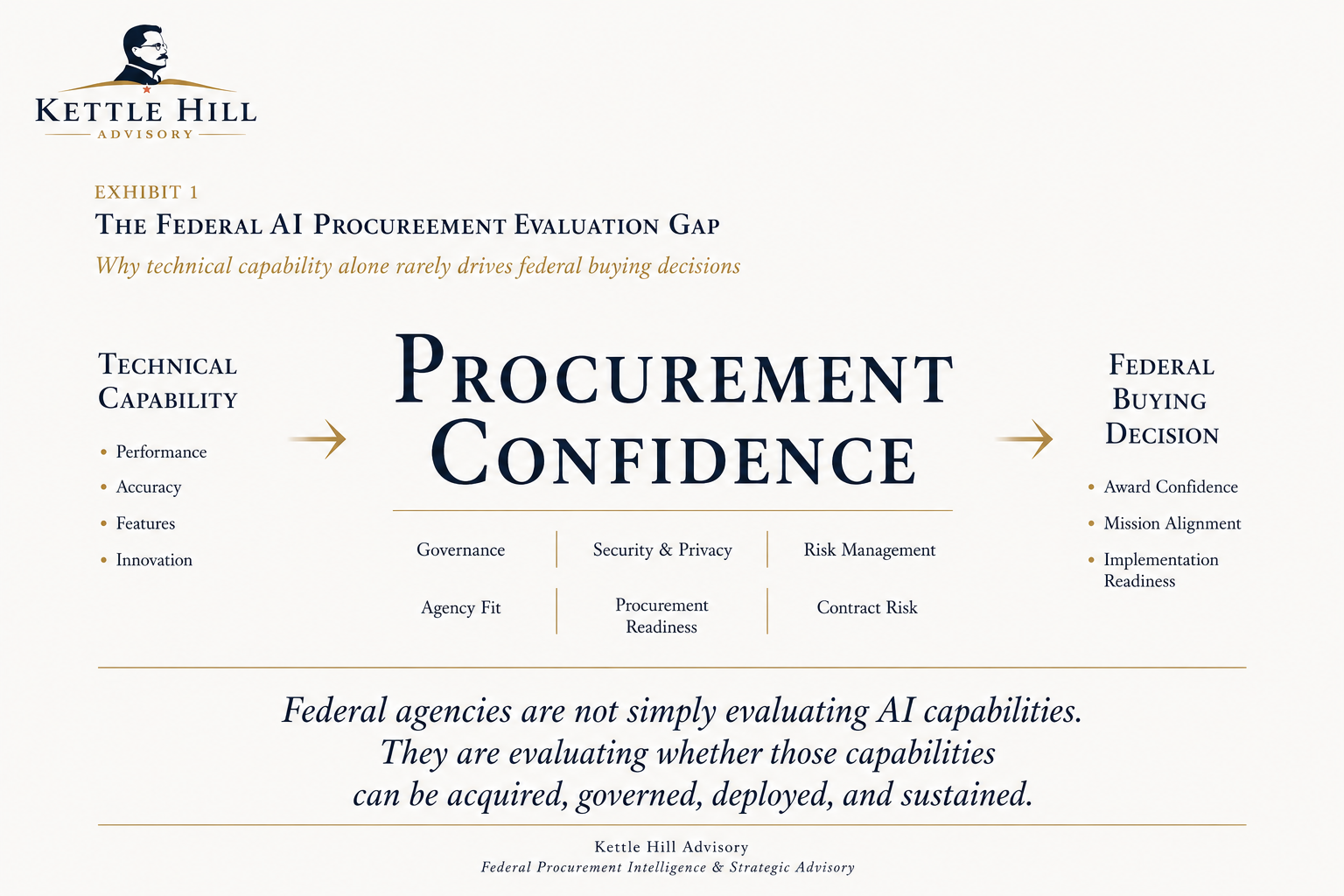
Recent guidance from the Office of Management and Budget (OMB), evolving agency governance requirements, General Services Administration (GSA) acquisition initiatives, and Government Accountability Office (GAO) findings all point toward the same conclusion: federal agencies are increasingly evaluating AI through a broader lens that includes governance, risk management, accountability, procurement readiness, and mission alignment.
Many organizations view federal AI opportunities as technology competitions. Increasingly, agencies evaluate them as risk-management decisions.
Federal agencies do not evaluate AI capabilities solely through a technology lens. Procurement officials, program managers, privacy officers, cybersecurity professionals, legal counsel, and senior leadership all play a role in determining whether an AI capability can be acquired, deployed, and sustained successfully.
The assumptions below are not always wrong. In certain circumstances they may be entirely reasonable. However, each has the potential to create strategic blind spots for organizations pursuing federal AI opportunities.
Assumption #1: Commercial AI Success Will Translate Cleanly Into the Federal Market
The federal government is actively seeking ways to accelerate adoption of commercial AI capabilities. OMB Memoranda M-25-21 and M-25-22, GSA's Buy AI initiative, and ongoing FedRAMP modernization efforts all reflect a desire to make innovative technologies more accessible to agencies.
That trend has led some organizations to assume that commercial success naturally leads to federal success.
The reality is more complex.
Commercial success demonstrates that a product solves a problem. Federal success requires demonstrating that the solution can operate within government acquisition, security, privacy, accountability, and contract-management requirements.
Federal buyers evaluate factors that often have no direct commercial equivalent, including data rights, cybersecurity requirements, privacy protections, procurement regulations, contract terms, past performance, and agency-specific mission needs.
Organizations must also increasingly consider the provenance and structure of the underlying AI ecosystem supporting their products. Questions regarding ownership, control, supply-chain dependencies, data stewardship, and domestic sourcing considerations are becoming more relevant as agencies evaluate long-term technology risk.
The most successful commercial firms entering the federal market recognize that federal acquisition is a distinct operating environment. They invest accordingly.
Commercial traction may open the door. It does not eliminate the need to understand how federal buyers evaluate risk.
Assumption #2:AI Governance Can Be Addressed Later
A common misconception is that governance becomes relevant only after an agency decides to adopt an AI capability.
Increasingly, that is no longer true.
Current federal guidance places significant emphasis on risk management, accountability, testing, human oversight, privacy protections, and documentation throughout the AI lifecycle. Agencies are often evaluating these issues before deployment decisions are made.
Many agencies continue to look to frameworks such as the National Institute of Standards and Technology (NIST) AI Risk Management Framework when developing governance approaches, even as implementation methods vary across government.
This reflects a broader reality.
Agencies are not simply acquiring software. They are often acquiring capabilities that may influence decisions, support mission-critical functions, process sensitive information, or affect public trust.
The federal government is not simply buying AI. It is buying confidence that AI can be deployed responsibly within a public-sector operating environment.
Organizations that delay governance discussions until after contract award may find themselves scrambling to create documentation, establish oversight processes, or define accountability structures under compressed timelines.
The more effective approach is to treat governance as part of procurement readiness. Organizations that can clearly explain how they manage risk, testing, accountability, and oversight often enjoy a significant credibility advantage during agency engagement.
Assumption #3: Technical Performance Will Be the Decisive Differentiator
Technical capability matters.
Federal agencies want solutions that perform effectively, solve mission problems, and deliver measurable results. Any discussion of federal AI acquisition that minimizes technical performance would be incomplete.
The challenge is that technical capability is rarely evaluated in isolation.
Federal acquisitions are generally structured as multi-factor evaluations. Technical merit may be considered alongside past performance, management approach, organizational capability, security posture, implementation risk, compliance requirements, and transition planning.
In practice, agencies are evaluating more than whether a solution works.
They are evaluating whether they can confidently acquire, deploy, govern, and sustain it.
This distinction becomes particularly important in emerging technology acquisitions. A technically impressive capability may still generate concerns if stakeholders are uncertain about data management practices, governance structures, implementation requirements, security implications, or operational accountability.
The most successful organizations understand that procurement confidence is often as important as technical performance.
The goal is not simply to demonstrate what an AI system can do.
The goal is to demonstrate why an agency should trust it.
Assumption #4: The Solicitation Will Tell Us What We Need To Know
Many contractors continue to approach federal opportunities as though the procurement process begins when the solicitation is released.
For AI acquisitions, that assumption is becoming increasingly risky.
Long before a solicitation appears, agencies may conduct market research, industry engagement, pilot activities, demonstrations, requirements development, and cross-functional acquisition planning. These activities often shape the requirements that eventually appear in procurement documents.
By the time a solicitation is released, agencies may already have formed views regarding available technologies, implementation challenges, governance concerns, and evaluation priorities.
This does not mean outcomes are predetermined.
Nor does it diminish the importance of responding effectively to solicitations.
It does suggest that organizations relying exclusively on solicitation review may be entering the conversation later than they realize.
Federal AI acquisition increasingly rewards organizations that understand agency priorities before formal requirements are finalized. Industry days, Requests for Information (RFIs), Draft Solicitations, market engagement activities, and acquisition planning discussions often provide valuable insight into how agencies are approaching emerging AI requirements.
The solicitation remains important.
It is simply no longer the beginning of the story.
Assumption #5: Federal AI Acquisition Is Primarily a Technology Problem
Perhaps the most significant misconception is the belief that federal AI acquisition is fundamentally a technology challenge.
Technology is certainly part of the equation.
But federal AI acquisition increasingly involves a broader set of institutional considerations.
Successful deployment often requires coordination among procurement officials, program leadership, privacy officers, cybersecurity personnel, legal counsel, mission owners, and technical teams. Each stakeholder brings a different perspective regarding risk, accountability, implementation, and operational success.
Many of the barriers agencies face are not limitations in AI capability itself.
They are challenges involving governance, workforce readiness, procurement processes, organizational capacity, security requirements, and institutional trust.
This helps explain why technically sophisticated solutions sometimes struggle to gain traction while less advanced offerings succeed.
The difference is often not the technology itself.
It is the organization's ability to align the technology with the acquisition environment surrounding it.
Organizations pursuing federal AI opportunities should resist the temptation to view procurement as a downstream administrative process.
In many cases, acquisition strategy is part of the product strategy.
Questions Leadership Teams Should Be Asking
As federal AI acquisition continues to evolve, leadership teams should consider several questions:
- Can we clearly explain our AI governance approach to procurement officials, privacy officers, and agency leadership?
- Are our AI-related claims supported by documentation, testing, and evidence that can withstand procurement scrutiny?
- Have we evaluated whether our ownership structure, technology dependencies, and supply-chain relationships create procurement risk?
- Are we actively engaging with agencies before solicitations are released?
- Do we understand how our target agencies are approaching AI governance, risk management, and acquisition planning?
- Could we confidently defend our AI-related claims during a source-selection evaluation or post-award review?
- Are we approaching federal AI opportunities as acquisition challenges as well as technology challenges?
Organizations that cannot answer these questions today may discover gaps at precisely the moment when the cost of addressing them is highest.
Understanding the Full Procurement Environment
Taken together, these assumptions reveal a common pattern.
Organizations often approach federal AI opportunities primarily through a technology lens, while agencies increasingly evaluate those opportunities through a broader framework that includes procurement, governance, risk, accountability, mission impact, and organizational readiness.
Federal AI adoption is accelerating, but policy developments alone do not determine procurement outcomes. The organizations that will be best positioned are those that understand how policy, governance, acquisition strategy, and mission requirements come together inside actual buying decisions.
The federal AI market is becoming more accessible to commercial technology providers. At the same time, it is becoming more structured, more closely scrutinized, and more integrated into existing acquisition processes.
The question is no longer whether agencies will acquire AI capabilities.
The question is whether contractors and technology providers understand how those capabilities will be evaluated.
Organizations that understand both technology and acquisition will be better positioned as federal AI adoption continues to evolve.
Continue the Conversation
Kettle Hill Advisory helps federal contractors, GovTech companies, and technology firms understand the evolving intersection of federal procurement, artificial intelligence acquisition, and government modernization.
For organizations evaluating their federal AI strategy, procurement readiness, or market positioning, we welcome the opportunity to continue the conversation.
Request a conversation at www.KettleHillAdvisory.com/contact.
