
What President Trump’s New Quantum Executive Orders Really Mean for the Federal Market
When the White House released two new executive orders on June 22, 2026, much of the initial coverage focused on the technology itself. That focus is understandable. Quantum computing has become one of the most closely watched emerging technology sectors in the world, with potential implications for scientific research, national security, advanced manufacturing, energy systems, artificial intelligence, and cybersecurity.
For federal contractors, however, the more important story may be the implementation machinery being built around the technology. President Trump’s executive orders establish new programs, planning requirements, investment initiatives, cybersecurity deadlines, and agency responsibilities that will shape the federal market long before large-scale quantum computing becomes operational.
Some of those developments remain research and development efforts. Others are already creating operational and acquisition pressure. The challenge for federal market participants is that those pressures are not emerging through a single government-wide procurement mandate. Instead, they are appearing through a combination of agency initiatives, technical standards, national security requirements, investment programs, and implementation plans.
That distinction matters because it changes where contractors, investors, and GovTech firms should be looking for market signals.
Two Executive Orders, Two Different Objectives
President Trump’s first executive order, Ushering in the Next Frontier of Quantum Innovation, focuses on accelerating American leadership in quantum technologies. His second executive order, Securing the Nation Against Advanced Cryptographic Attacks, focuses on preparing federal systems for the security implications of future quantum breakthroughs.
Viewed together, the orders establish two parallel tracks. One is designed to accelerate the development and commercialization of quantum capabilities. The other is intended to prepare federal agencies for a future in which quantum computing may threaten existing cryptographic systems.
Although these tracks are related, they create different opportunities, different timelines, and different implications for industry.
The Most Concrete Signal in the Quantum Innovation Order
Much of federal technology policy is expressed through broad strategic ambitions. The first quantum executive order contains something more tangible.
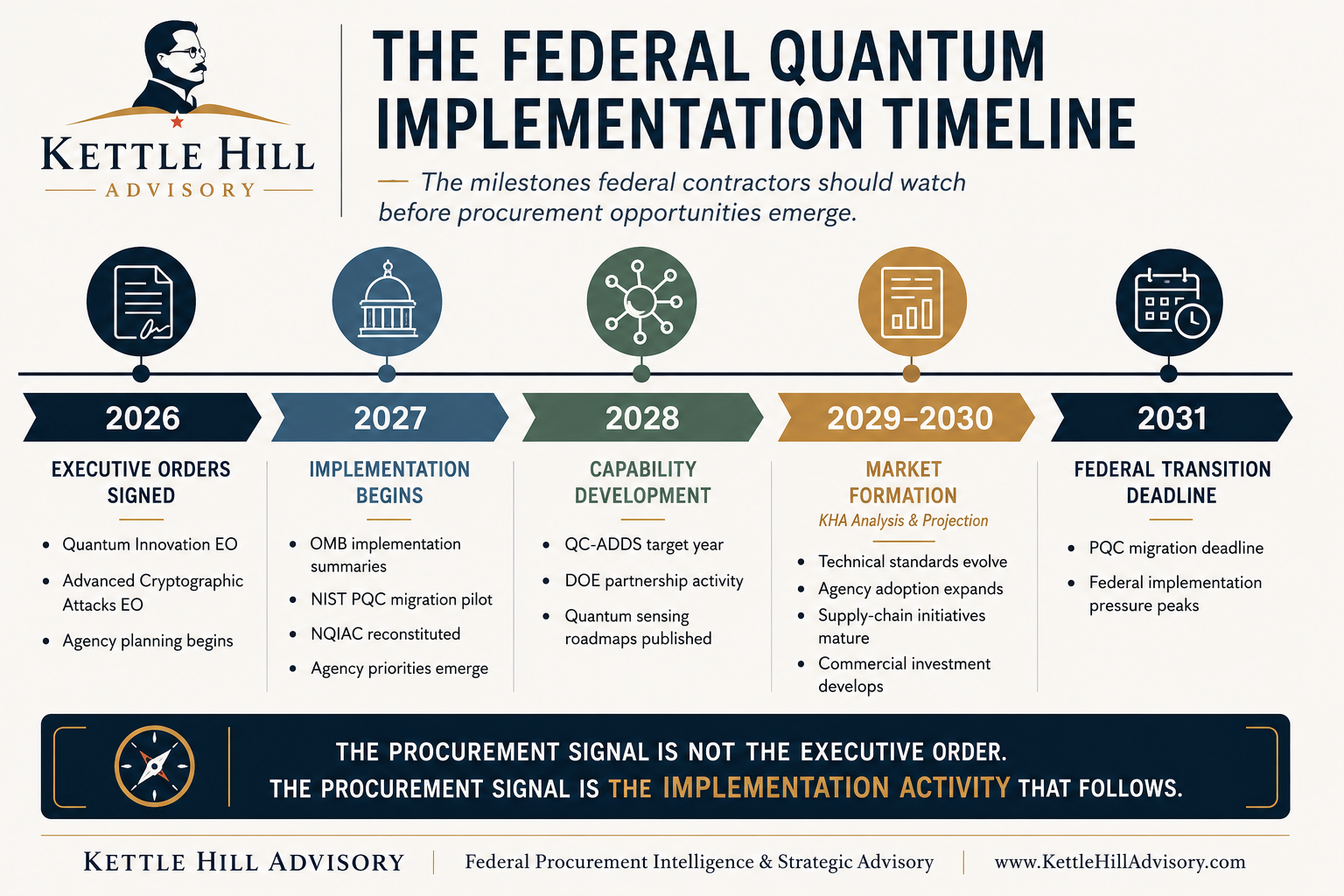
The order establishes the Quantum Computer for Application Development and Discovery Science (QC-ADDS) Effort and directs the Department of Energy to pursue a scientifically relevant quantum computing capability by 2028.
For contractors and investors, that detail matters more than general statements about supporting innovation. Unlike broad policy aspirations, named federal programs create accountability and force agencies to begin translating strategic objectives into implementation plans, technical requirements, and eventually acquisition activity.
The QC-ADDS effort should be viewed as one of the clearest federal signals currently available regarding where the Trump Administration wants quantum computing development to move over the next several years.
The order also directs the Department of Energy to identify partnership models capable of leveraging private-sector expertise in support of the effort. That creates an opportunity for quantum companies, research institutions, national laboratory contractors, and technology firms seeking visibility into how federal requirements may evolve before major acquisition activity begins.
While the Administration’s broader quantum strategy spans workforce development, commercialization, supply-chain resilience, and international cooperation, QC-ADDS represents the most concrete implementation initiative in the order and therefore the clearest procurement signal available today.
The order also requires agencies to provide implementation summaries to the Office of Management and Budget within 30 days of publication of the updated National Quantum Strategy. That requirement creates an early mechanism for tracking how agencies intend to translate the Administration’s quantum priorities into operational activities and may provide one of the first indicators of where implementation efforts are gaining traction.
Why Quantum Sensing May Matter More Than Quantum Computing
One of the most overlooked aspects of the executive order is its treatment of quantum sensing.
Much of the public conversation around quantum technology focuses on computing. The Trump Administration appears to be taking a broader view.
The order directs the Departments of Commerce, Energy, and Defense, along with NASA, to develop five-year plans for quantum sensing and networking activities. Those plans may ultimately prove more significant than many observers currently appreciate.
Quantum sensing technologies have potential applications across defense, intelligence, positioning and navigation, infrastructure monitoring, environmental observation, geospatial analysis, and scientific research. Many of these applications are likely to reach operational environments sooner than large-scale quantum computing.
For companies attempting to identify where federal demand may emerge first, quantum sensing deserves considerably more attention than it currently receives.
Just as important, the five-year agency roadmaps required by the order may become some of the most valuable market intelligence documents in the sector once they are released.
The executive orders establish the direction of travel. The roadmaps are likely to reveal the destination.
The Post-Quantum Cybersecurity Story Is More Complicated Than It Appears
The second executive order may ultimately have more immediate implications for federal contractors than the quantum innovation order.
It establishes a government-wide timeline.
Federal agencies are directed to complete migration to post-quantum cryptography for designated systems by December 2031. The order also directs a National Institute of Standards and Technology-led pilot migration effort by the end of 2027.
Those are concrete milestones. They provide agencies, vendors, and investors with something more useful than a strategic aspiration. They provide a timeline.
At the same time, contractors should avoid oversimplifying the procurement implications.
A common interpretation is that post-quantum cybersecurity is steadily progressing toward a new government-wide acquisition mandate. The reality is more nuanced.
In June 2025, Executive Order 14306 rolled back several Biden-era cybersecurity requirements, including procurement-related provisions associated with post-quantum cryptography adoption. As a result, the current environment is not a straightforward march toward a universal federal mandate.
Instead, acquisition pressure is emerging unevenly.
Some requirements are arriving through agency-specific actions. Others are emerging through national security requirements, technical standards, implementation guidance, and modernization initiatives.
That distinction is particularly important for contractors supporting national security systems. Organizations operating in Defense Department and intelligence community environments are already encountering post-quantum cryptography expectations through national security requirements and CNSA 2.0 implementation activities that operate independently of civilian agency timelines.
The title of the executive order itself is instructive. Rather than framing the challenge as a technical modernization effort, President Trump framed it as a national security issue. That distinction increases the likelihood that implementation pressure will emerge not only through civilian agency modernization initiatives but also through national security requirements, intelligence community activities, and defense-sector standards.
The practical effect may ultimately be similar. Contractors will face increasing pressure to demonstrate cryptographic modernization readiness. The path to that outcome, however, is likely to be more fragmented than many headlines suggest.
Where Contractors Should Watch for Procurement Signals
The most valuable information contained in these executive orders may not be the executive orders themselves. It may be the implementation activities they trigger.
Several developments deserve close attention over the next 12 to 24 months.
First, agencies are required to develop implementation plans and provide updates through established oversight mechanisms. Those documents often reveal priorities long before procurement activity becomes visible.
Second, the National Quantum Initiative Advisory Committee is scheduled for reconstitution. Its membership, recommendations, and tasking will provide insight into where policymakers believe the greatest opportunities and challenges exist.
Third, the Commerce Department is directed to develop investment-oriented initiatives supporting commercial quantum development. Those efforts may become important indicators of where the federal government sees strategic industrial priorities.
Fourth, the quantum sensing and networking roadmaps required from Commerce, Energy, Defense, and NASA may become some of the most important planning documents in the sector.
Finally, the NIST pilot migration effort and the broader post-quantum cryptography transition timeline will create a series of implementation decisions that agencies, cloud providers, cybersecurity firms, software vendors, and systems integrators will all need to address.
For companies seeking early market intelligence, these activities deserve at least as much attention as future solicitations.
What These Orders Reveal About the Trump Administration’s Technology Strategy
The executive orders also offer insight into how the Trump Administration appears to be approaching emerging technologies more broadly.
Rather than focusing exclusively on research funding, the Administration is attempting to build supporting ecosystems around strategically important technologies. The orders combine research and development objectives with workforce initiatives, supply-chain activities, commercialization efforts, public-private partnerships, investment mechanisms, standards development, cybersecurity planning, and implementation oversight.
Elements of the same model have appeared across artificial intelligence, semiconductors, cybersecurity, advanced manufacturing, and other technology policy initiatives. The objective is not merely to support technological advancement. It is to create the conditions necessary for technological adoption, operational use, and long-term strategic advantage.
That does not mean procurement opportunities will emerge immediately. It does suggest that agencies are beginning to build the institutional infrastructure that often precedes sustained acquisition activity.
The Federal Market Implication
The most important takeaway from these executive orders is not that quantum computing has suddenly become a major procurement category.
It has not.
Nor do the orders create a sweeping new government-wide acquisition mandate.
What they do create is a growing set of implementation activities that federal contractors, technology companies, and investors should not ignore.
The QC-ADDS effort establishes a named quantum computing initiative with a 2028 target. The post-quantum cybersecurity order establishes a December 2031 migration deadline and a 2027 pilot effort. Multiple agencies must now develop planning documents that will help define future priorities. Investment initiatives, advisory bodies, workforce programs, supply-chain activities, and public-private partnerships are all being expanded.
None of those developments guarantee procurement opportunities. Taken together, however, they create acquisition pressure that is likely to shape future federal demand.
Over the next several years, the most important documents in this market may not be procurement solicitations. They may be the quantum sensing and networking roadmaps produced by Commerce, Energy, Defense, and NASA; the implementation decisions surrounding the 2027 NIST migration pilot; the recommendations emerging from the reconstituted National Quantum Initiative Advisory Committee; and the evolution of the QC-ADDS effort as it moves toward its 2028 target.
Organizations that monitor those signals closely will likely have a clearer view of future federal demand than those waiting for opportunities to appear in SAM.gov. The executive orders establish the direction of travel. The implementation documents that follow will determine where the market ultimately goes.
