
Why the Ability to Prove AI Claims May Become as Important as the Claims Themselves
For years, the conversation around artificial intelligence procurement focused primarily on capability.
Could the technology perform the task?
Was it more accurate, faster, less expensive, or more scalable than existing approaches?
Those questions remain essential. Federal agencies are not going to purchase ineffective technology simply because it comes with polished governance documentation.
But a different question is increasingly emerging alongside traditional performance considerations:
Can the government trust the evidence behind the claims?
That distinction may become increasingly important as agencies move from experimenting with AI to acquiring and operating it at scale.
Across the federal government, policymakers are constructing governance frameworks, risk-management expectations, oversight processes, testing requirements, and accountability mechanisms for AI systems. Current Office of Management and Budget (OMB) guidance, agency governance structures, Government Accountability Office (GAO) oversight work, proposed acquisition clauses, and National Institute of Standards and Technology (NIST) risk-management concepts all point in a similar direction.
The federal government is not merely trying to acquire AI.
It is increasingly trying to acquire AI that can be understood, monitored, justified, and managed.
That creates a new challenge for both agencies and contractors.
The challenge is evidence.
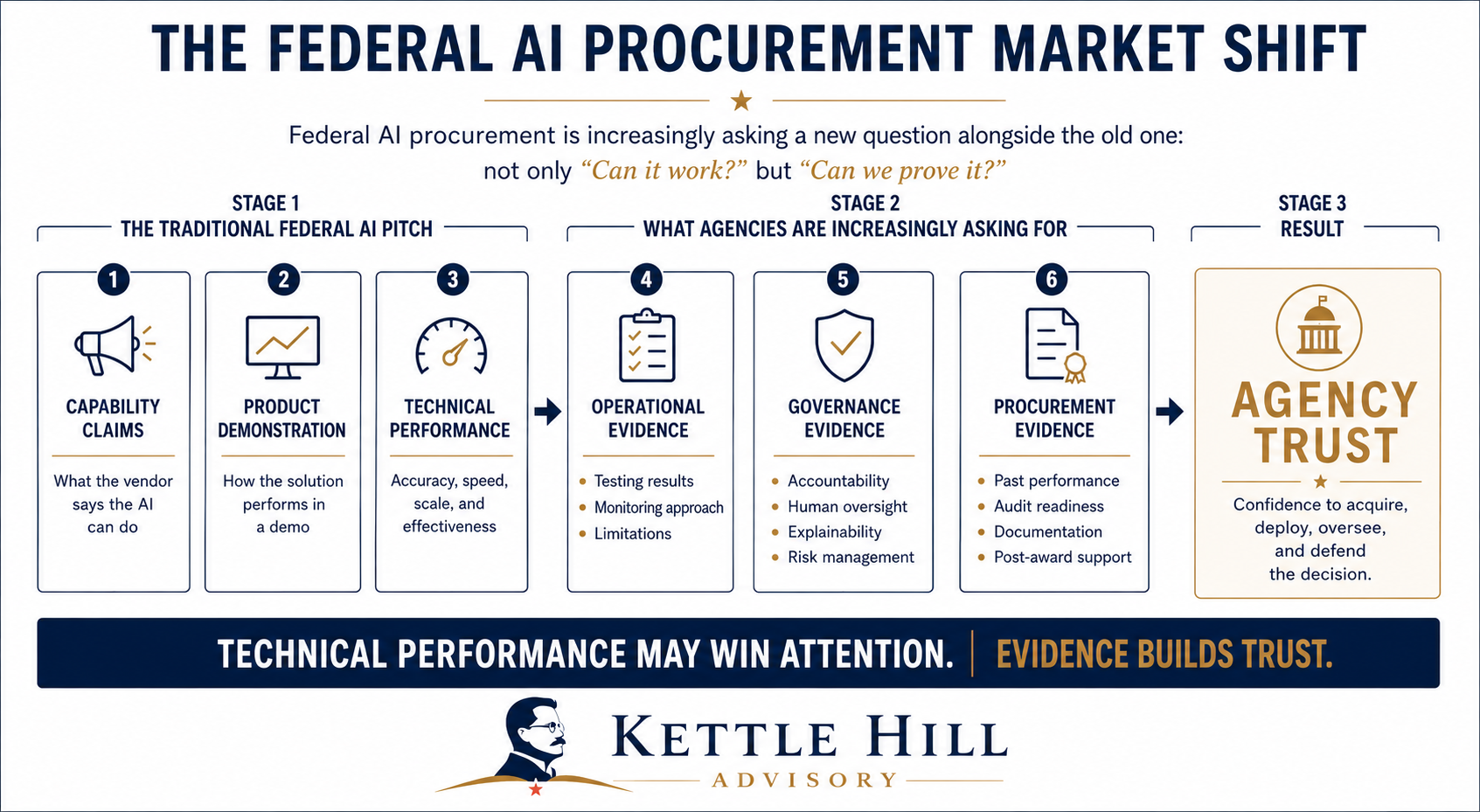
Agencies Are Being Asked to Make More Complex Buying Decisions
Artificial intelligence introduces a different type of acquisition risk than traditional software.
When an agency acquires cloud infrastructure, network services, or collaboration tools, procurement questions are relatively familiar. Agencies evaluate functionality, cybersecurity, price, integration requirements, and vendor performance.
AI introduces additional layers of uncertainty.
How was the model trained?
What data was used?
What limitations are known?
How is performance measured?
How are errors identified and corrected?
What role does human oversight play?
How are risks monitored over time?
These questions become especially important for higher-impact AI systems that influence significant agency decisions, public services, safety outcomes, benefits determinations, enforcement activities, or other functions with meaningful consequences.
Current federal policy places the greatest governance expectations on these higher-impact use cases, but the broader direction is clear: agencies are increasingly expected to understand not only what an AI system does, but how it does it and how it will be managed over time.
That pressure changes what agencies need from vendors.
Technical performance remains necessary.
Evidence becomes increasingly important.
The Emerging Evidence Problem
The most important finding from recent federal AI guidance may not be the guidance itself.
It may be the gap between what agencies are expected to evaluate and what they are currently equipped to evaluate.
In April 2026, GAO published report GAO-26-107859, Artificial Intelligence Acquisitions: Agencies Should Collect and Apply Lessons Learned to Improve Future Procurements. The review examined thirteen AI acquisitions across the Department of Defense, Department of Homeland Security, General Services Administration, and Department of Veterans Affairs.
GAO identified recurring acquisition challenges involving testing and evaluation, requirements definition, access to technical expertise, pricing, data rights, and acquisition management.
In other words, agencies were not struggling simply to buy AI.
They were struggling to determine whether vendor claims could be evaluated, validated, and managed throughout the acquisition lifecycle.
This creates an uncomfortable reality.
Agencies are increasingly expected to ask sophisticated questions about AI governance, testing, risk management, transparency, monitoring, and accountability.
Many agencies are still building the institutional capacity necessary to answer those questions consistently.
The result is an evidence problem.
Government buyers need evidence that a vendor’s claims are credible.
At the same time, the government’s ability to independently validate every claim remains uneven.
That reality creates an important strategic implication for contractors.
The burden of proof is gradually shifting toward vendors.
Why Documentation Is Becoming Procurement-Relevant
Many companies still treat AI governance as primarily a legal, compliance, or public-relations issue.
Federal procurement increasingly gives it operational significance.
Documentation serves multiple purposes simultaneously.
It helps agencies satisfy governance requirements.
It supports oversight and audit activities.
It allows program managers to understand how systems operate.
It creates a foundation for ongoing monitoring and evaluation.
Most importantly, documentation converts claims into evidence.
A vendor can claim that a model has been tested.
Evidence shows how it was tested.
A vendor can claim that risks have been mitigated.
Evidence demonstrates what controls exist.
A vendor can claim that outputs are reliable.
Evidence explains how reliability was measured.
This distinction may seem subtle.
In practice, it can become the difference between a promising technology demonstration and a procurement-ready offering.
The NIST AI Risk Management Framework, while voluntary in origin, has increasingly become the common reference point for how agencies and vendors discuss AI governance, risk management, testing, oversight, and documentation. In practice, it is helping establish a shared vocabulary for evaluating AI maturity across the federal acquisition environment.
At least in some environments, governance documentation is beginning to move earlier in the acquisition process. GSA’s internal AI governance directive requires Chief AI Officer review and approval before certain AI-related solicitations are released. While this is not a government-wide requirement, it illustrates how governance considerations can increasingly shape acquisition planning before proposals are ever submitted.
The Incumbent Advantage Nobody Talks About
The evidence problem does not affect every vendor equally.
Established federal contractors often possess advantages that have little to do with model performance.
They understand procurement processes.
They understand documentation expectations.
They understand how agencies evaluate risk.
They possess relevant past performance.
They maintain compliance and capture infrastructures designed specifically for government customers.
Commercial technology companies entering the federal market frequently lack those advantages.
Many possess strong technical capabilities.
Some possess superior technical capabilities.
But they often underestimate how much of federal procurement revolves around reducing uncertainty rather than maximizing innovation.
Commercial firms frequently arrive prepared to demonstrate what their technology can do.
Federal buyers often want to understand how the technology will be governed, monitored, documented, tested, supported, and managed throughout contract performance.
These are fundamentally different conversations.
For commercial AI companies entering the federal market, this distinction may be one of the most important strategic realities to understand. The challenge is rarely limited to proving that a system works. The challenge is proving that the system can operate successfully within a federal accountability environment.
The companies that recognize that distinction early are often better positioned than those that discover it during proposal development.
Policy Signals Are Not Procurement Reality
A critical caveat is necessary.
The federal market has not suddenly transformed.
Most agencies are not scoring AI governance as a dominant source-selection factor.
Technical approach, mission fit, past performance, schedule, security, and price continue to shape procurement outcomes.
Many current solicitations reflect requirements developed long before the latest AI guidance was issued.
Policy changes often take years to fully influence procurement behavior.
This distinction matters.
Current OMB memoranda primarily establish expectations for civilian agencies. They do not automatically impose requirements on contractors, nor do they apply uniformly across the federal government. For example, OMB Memorandum M-25-22 governs civilian-agency AI acquisition but does not apply to the Department of Defense or National Security Systems.
Contractors are affected when agencies translate policy expectations into acquisition planning, technical requirements, evaluation criteria, contract terms, and oversight practices.
That process takes time.
Federal procurement rarely changes overnight.
Yet it would be a mistake to ignore the signals.
The direction of travel is increasingly clear even if implementation remains uneven.
Not Every Part of Government Is Moving in the Same Direction
Another important distinction is often overlooked in discussions of federal AI acquisition.
The civilian acquisition environment and the national security acquisition environment are increasingly operating under different policy impulses.
For civilian agencies, recent OMB guidance emphasizes governance, risk management, oversight, accountability, and responsible deployment, particularly for higher-impact AI systems.
Defense acquisition is simultaneously experiencing a different pressure.
The Department of Defense’s January 2026 Artificial Intelligence Strategy for the Department of War argues that the risks of moving too slowly outweigh the risks of imperfect alignment. The strategy prioritizes accelerated adoption, rapid deployment, and removal of non-statutory barriers that delay operational implementation.
This does not invalidate the evidence-era thesis.
It defines its scope.
The strongest governance expectations are currently emerging within the civilian acquisition environment, while defense organizations are balancing governance objectives against an explicit demand for speed. Both trends can exist simultaneously.
The Market Signal Hidden in Current AI Policy
The most interesting development may not be governance itself.
It may be what governance requirements reveal about how agencies think about risk.
Federal buyers are increasingly looking for ways to distinguish between vendors that merely claim maturity and vendors that can demonstrate maturity.
That distinction affects more than compliance.
It affects credibility.
In many cases, governance documentation functions as both operational evidence and market signaling.
A contractor that can clearly explain testing procedures, risk-management practices, oversight mechanisms, monitoring approaches, and known limitations sends a signal that extends beyond the documentation itself.
It signals preparedness.
It signals organizational maturity.
It signals lower acquisition risk.
There is an important nuance, however.
GAO’s findings suggest many agencies still face workforce and expertise constraints when evaluating AI acquisitions. In the near term, that means governance documentation may serve both a substantive function and a signaling function. Vendors are not simply demonstrating that governance processes exist. They are demonstrating those processes in ways that acquisition professionals, program managers, attorneys, oversight officials, and executive decision-makers can understand and evaluate.
Documentation that is technically sophisticated but difficult to interpret may be less effective than documentation that is both rigorous and accessible.
That reality creates a practical challenge for contractors.
The goal is not simply to generate more documentation.
The goal is to generate evidence that decision-makers can use.
What Contractors Should Be Doing Now
The practical implications are straightforward.
Organizations pursuing federal AI opportunities should begin evaluating whether they can substantiate the claims they make about their systems.
That means understanding how performance is measured, documenting testing methodologies, identifying known limitations, maintaining defensible governance processes, and preparing to support government oversight activities when required.
The strongest competitors will likely be the firms that build this evidence before agencies ask for it.
Not because every solicitation currently requires it.
But because the acquisition environment is increasingly moving in that direction.
Waiting until a proposal deadline to answer governance questions is often too late.
The Next Competitive Advantage
Federal AI procurement is still evolving.
Implementation remains uneven.
Agency capabilities vary.
Policy guidance continues to change.
Technical performance remains the foundation of successful federal AI acquisition, and governance considerations have not displaced traditional evaluation factors such as mission fit, past performance, security, schedule, and price.
But the broader trend is increasingly difficult to ignore.
Federal agencies are being asked to govern AI more rigorously.
That expectation creates demand for evidence.
The companies best positioned to compete will not simply be those with impressive AI capabilities.
They will be the companies that can demonstrate those capabilities in ways that withstand procurement scrutiny, oversight review, and operational reality.
The next competitive advantage in federal AI may not be the ability to make stronger claims.
It may be the ability to prove them.
